

SIMS — Smart Integrated Manufacturing System.
End-to-end ERP and manufacturing tracking system built for a multi-brand bag manufacturer, from order intake to shipment.
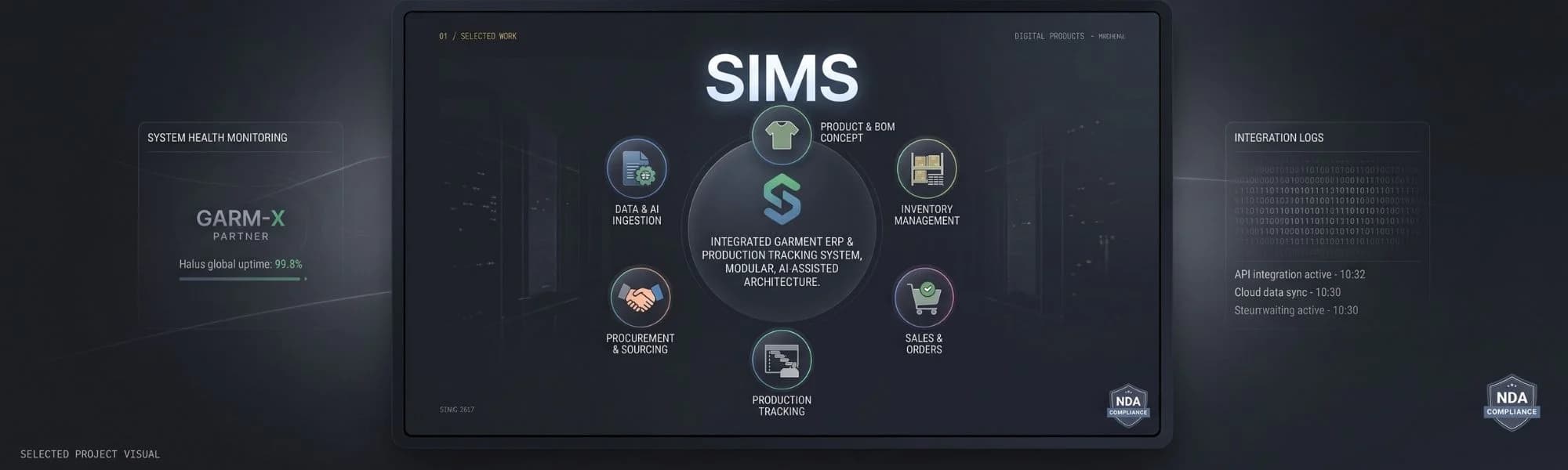
PRODUCT PREVIEW
Business system
Internal teams: merchandising/PPIC, purchasing, warehouse (incoming & finished goods), QC (incoming and inline/final inspection), production floor supervisors, and management reporting on production and shipment status.
Internal
01 / The product
SIMS connects order intake, bills of materials, purchasing, inventory and factory-floor tracking for contract manufacturing. A shared data model links the ERP workflow to sequential production stages: cutting, sewing, quality control and packing.
Contract manufacturing where multiple buyers' specifications, materials, cost structures and shipment schedules run in parallel. Incoming quality control and lot-level traceability connect purchasing with production records.
The problem
Production data lived across spreadsheets and a legacy Ecount instance, with no single source of truth connecting a buyer's PO to the material purchased, the factory floor stage it was in, or the shipment it eventually left on. Revisions to quantity, schedule, or specification had no consistent trail, making it hard to answer "where is this order right now" without manual cross-checking.
02 / How it works
- 01Development
- 02Order intake
- 03Purchasing (BOM explosion to PO)
- 04Goods receipt + incoming QC
- 05Inventory (lot-tracked)
- 06Production
- 07Finished-goods packing and shipment allocation
- 08Planned next stage: export documentation and payment tracking
Key features
- BOM versioning by clone across sample stages, SKUs, and seasons
- Automatic material list generation from BOM × order quantity, split into purchase orders per vendor
- AQL-based incoming QC with waiver workflow
- Lot-tracked inventory tied to source PO and SO, with stock movement and reservation tracking
- Stage-gated production tracking (cutting → sewing → inline QC → final QC → packing)
- Shipment allocation that preserves order-line totals across multiple partial shipments
- Finished-goods packing, carton records and shipment preparation
03 / Development
Development & AI
Claude Code supports software development and documentation: translating workflow requirements into reference material, reviewing proposed schemas against business rules and maintaining architecture decisions. No user-facing AI feature is claimed for the ERP.
Engineering considerations
Designing a data model that could integrate with a legacy production tracker already live in production — without duplicating tables it already owned or breaking real-time features it depended on. Supporting controlled post-release revisions to sales-order quantities and prices, with an audit trail and downstream quantity adjustments that respect production already completed.
Technology
04 / Current stage
Built for a team’s internal operations; not offered as a public app. The case study explains its scope and limits.
An internal ERP implementation connecting orders, materials, quality control and production records. Rollout scope requires operational validation. Automatic reservation at sales-order creation, commercial invoice and export packing-list generation, and payment tracking remain planned capabilities.
SIMS — Smart Integrated Manufacturing System
Manufacturing ERP / 2026Product views
Need a workflow like this?
Share how your team works today and what needs to connect. We can discuss a custom web app, business system or automation shaped around that process.